Single-Strand Barbed Wire

Single-strand barbed wire

Single-strand barbed wire originated at the turn of the 19th and 20th centuries, when American farmers faced the need to control and limit the movement of large herds. The shortage of timber for building fences and enclosures forced farmers to improvise. Early structures using single-strand barbed wire consisted of stand-alone posts placed at certain intervals (depending on the terrain), between which the wire itself was stretched. Additional wooden planks were often mounted between the posts to reinforce the structure.

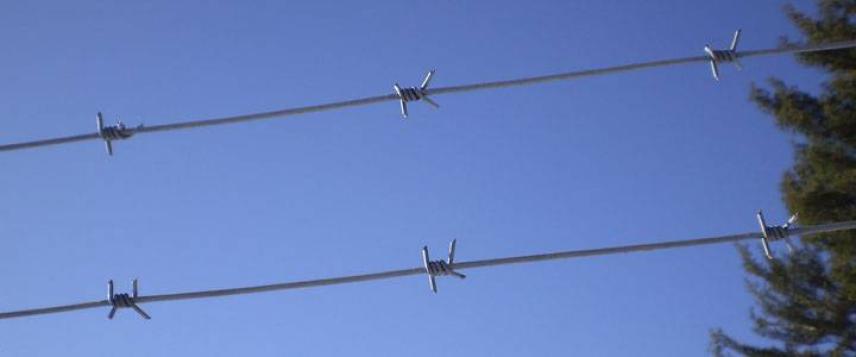
This period marked the emergence of what is now known as single-strand barbed wire. Its design is based on a steel wire onto which short segments of identical wire are twisted at regular intervals to form small barbs. At the points where the barbs are attached, the main wire is specially indented or serrated to prevent barbs from sliding out of place. For improved durability, the wire is galvanized – a feature typical not only of single-strand barbed wire but of almost all types of wire fencing.

Design of single-strand barbed wire

According to modern standards, the distance between the centers of the barbs on single-strand barbed wire should be approximately 75 mm, and the length of each barb around 20 mm. A few additional specifications help illustrate the nature of this material. The diameter of the main wire is 2.8 mm, while the wire used to form the barbs has a smaller diameter of 2 mm. The zinc coating density is 80 g/m² for the main wire and 60 g/m² for the barbs. The approximate weight of one meter of barbed wire is about 87-88 g. One kilogram of wire contains roughly 11-12 meters of single-strand barbed wire. For sale and transportation, the wire is packed into special coils shaped like short cylinders with an outer diameter of roughly 600 mm and an inner diameter of 100-150 mm. A fully packed coil can weigh up to 30 kg. When large quantities are shipped, coils are bundled into sets of five.

Today, single-strand barbed wire is primarily used in the installation of perimeter protection systems for preventing unauthorized access. This application – the use of wire barriers against people – traces back to World War I. Later, barbed wire became widely used around prisons to impede escape attempts. Single-strand barbed wire also served as the basis for more advanced structures, such as the Bruno spiral, and contributed to the development of modern protective barriers and fencing systems.

It is worth noting that single-strand barbed wire remains the most economical type of material used for securing territories. Its field of application is ideal for small businesses, private properties, and other facilities where the likelihood of deliberate intrusion is relatively low.