Motion sensors

Infrared motion sensors

Motion sensors are devices capable of detecting the movement of objects and people within a monitored area. In everyday life, motion sensors typically refer to infrared sensors that respond to changes in radiation.

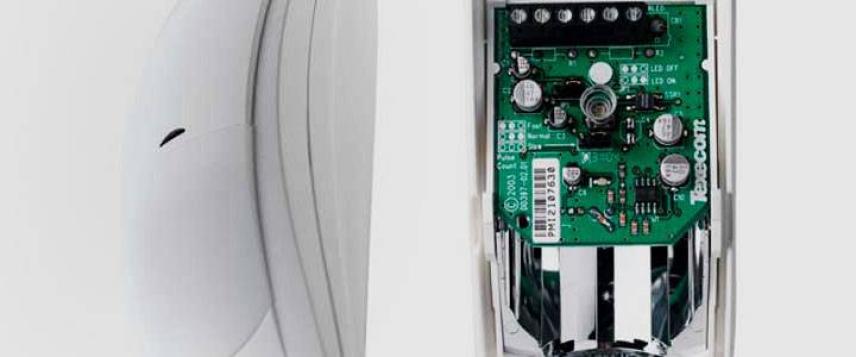
The operating principle of a motion sensor can be described as follows. The human body has a temperature of approximately 36-37 degrees Celsius and emits infrared waves. These waves are detected by a sensitive pyroelectric detector – motion sensor itself. The device itself consists of so-called Fresnel lenses and an infrared sensor. The optics are typically located at a distance of one and a half to two centimeters. The optical system consists of 20 to 60 gray or milky lenses that focus the received infrared waves on the infrared sensor. The number and placement of the lenses determine the size of the zone monitored by the motion sensor. The signal generated by the sensor is fed to an amplifier, where it is significantly amplified, converted to digital format, and ultimately sent to a relay, at which point the contacts close and an alarm is generated. The main condition for reliable operation of the sensor is the requirement that the temperature gradient in the room or outside – where the sensor is installed – differs by 5 degrees.

The main parameters that can be changed by the owner of the protected property to obtain the most reliable information about the protected property are the following:

  • Disabling time interval. This setting is necessary to disable the sensor after the last movement; the interval can be between 5 seconds and 10 minutes.
  • Required lighting level. This function creates the conditions necessary for the motion sensor to operate given the existing lighting. Generally, if the lighting level is below the required level, the motion sensor is triggered automatically.
  • Sensitivity level. This is simple – the higher the sensitivity level, the greater the likelihood of triggering in the event of movement.

To ensure the best level of protection for a property, the following parameters must be considered.

  • The location of the motion sensor is an important factor when purchasing. Different sensors have different mounting options and varying levels of protection against dust and moisture (if outdoor installation is required).
  • Detection Zone Equipment. It's important to remember the requirement stated at the outset that the sensor has a specific range. Therefore, when selecting a motion sensor, it's important to consider the room's size and the presence of foreign objects. Materials such as glass do not transmit infrared radiation, while additional objects such as curtain rods and chandeliers degrade the signal quality.
  • Sensor Viewing Angle. This determines the sensor's placement. The angle covered by motion sensors can range from 180 to 360 degrees. For example, sensors with a 180-degree angle are suitable for use in entry/exit monitoring systems.
  • Setting the On/Off Time. This is a feature worth considering, as at large facilities requiring multiple motion sensors, employees should plan their routes to avoid the active sensors.

Using motion sensors significantly increases the level of facility security and monitoring. Moreover, motion sensors are one of the most effective elements of security alarm systems. Careful selection and installation of motion sensors will ensure reliable performance and a long service life of your security equipment.