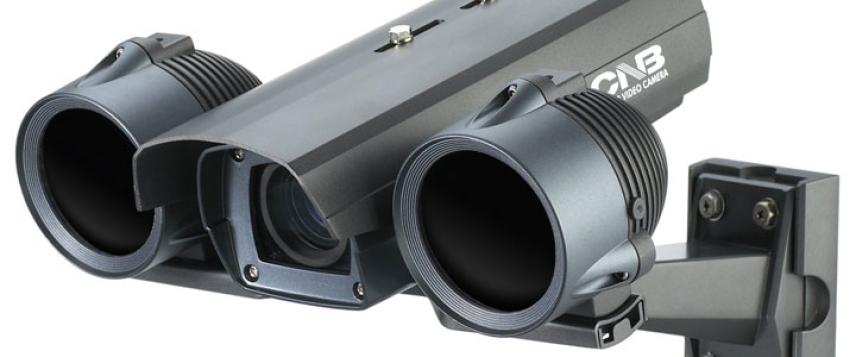
Surveillance cameras are optoelectronic devices that form a video signal from the light flow passing through the camera lens onto the sensor.
CCD sensors come in sizes of 1/4, 1/3, 1/2, and 1 inch. Most commonly, 1/3-inch sensors are used in cameras. The larger the sensor, the more light it captures and the higher the image quality, but the cost also increases.
The lens is the optical part of the camera directed at the observed object and forming its image on the sensor. Lenses consist of a set of optical elements and can have fixed or variable focal length. The focal length of the lens is the distance from its optical center to the sensor. The table below shows the relationship between focal length and camera field of view.
| Focal length of the lens, mm | Horizontal camera viewing angle, degrees | Camera vertical viewing angle, degrees |
|---|---|---|
| 2,5 | 120 | 90 |
| 2,9 | 104 | 78 |
| 3,4 | 94 | 70 |
| 3,5 | 79 | 63 |
| 3,6 | 72 | 54 |
| 3,7 | 70 | 52 |
| 4 | 65 | 48 |
| 4,3 | 62 | 47 |
| 5,5 | 55 | 40 |
| 6 | 42 | 32 |
| 8 | 32 | 24 |
| 12 | 22 | 17 |
| 16 | 17 | 12 |
| 25 | 11 | 8 |
| 50 | 5,5 | 4 |
| 75 | 3,7 | 2,8 |
Resolution of a surveillance camera is measured in television lines. In PAL (color) and CCIR (monochrome) formats, there are 625 vertical lines. Horizontal resolution is determined by the number of vertical lines transmitted to the display.
Sensitivity of a surveillance camera refers to the minimum illumination at which the camera produces a signal with a defined modulation depth and an amplitude of 1 V. Sensitivity is measured in lux (Lux). The higher the sensitivity, the better the image quality in low-light conditions.
Automatic Gain Control (AGC) increases the camera’s output signal when the sensor does not produce sufficient signal under low-light conditions. Automatic gain control (Automatic Gain Control) adjusts the incoming signal to maintain it at the required level, improving image quality in low illumination.
The iris is a lens device that increases or decreases the amount of light reaching the sensor. The electronic shutter changes the charge accumulation time on the sensor from 1/100000 to 1/50 second, i.e., the readout period.
Signal-to-noise ratio indicates the quality of the video signal coming from the camera. Noise appears as “snow” on the image. This ratio should be 45 dB or higher. Noise is reduced by using a high-quality sensor, a high-aperture lens, and DNR digital noise reduction (Digital Noise Reducksion). Today, 2D (processing individual frames presumed to contain noise) and 3D (inter-frame pixel correction analysis) technologies are used. The 2D method better suppresses noise in moving objects, while 3D is more effective for static scenes. Combined 2D+3D filtering provides even better results.
BLC backlight compensation (High Light Compensation) allows the camera to transmit dark areas against a bright background, for example, when facing car headlights.
ATW white balance (Auto Tracking White Balance) is a video-signal processing system that enables the camera to accurately reproduce object colors regardless of the type of illumination – automatic white balance control.
WDR wide dynamic range (Wide Dynamic Rage) uses dual-scan sensors to capture two sub-frames with different exposures. Their combination produces a single frame where both dark and bright areas are clearly visible.
In many cases, external influences cause the camera to shake. The image stabilization function (Digital Image Stabilizer) helps eliminate this shaking.